Dealing with a pool leak?
Call us at 214-972-3330 for professional detection and repair
You’re adding water to your pool every few days. You’ve walked around the deck looking for wet spots. You’ve checked the equipment pad for drips. Nothing.
Yet the water level keeps dropping.
This is one of the most frustrating situations for pool owners — and one of the most common calls we get. The good news: there’s always an explanation. The challenge: finding it often requires looking in places you can’t see.
Before assuming you have a leak, confirm that water loss isn’t just normal evaporation.
In North Texas, pools typically lose ¼ to ½ inch of water per day during hot summer months. That’s normal. Wind, sun exposure, humidity, and water temperature all affect evaporation rates.
The Bucket Test
This simple test separates evaporation from leaks:
If the pool lost significantly more water than the bucket, you have a leak — not just evaporation.
If both levels dropped the same amount, evaporation is your culprit.
When you can’t see a leak, it’s usually in one of these locations:
Your pool has pipes buried beneath the deck and yard connecting the pool to your equipment. These pipes can:
You won’t see water pooling because it’s absorbing into the soil underground. Sometimes the only sign is a patch of grass that’s greener than the rest — or soil that’s always damp in one area.
The skimmer is embedded in concrete at the junction of your pool wall and deck. Over time — especially in North Texas clay soil — the connection between skimmer body and pool shell separates.
Water escapes behind the skimmer, flows into the ground, and you never see a drop. The only clue: your water level stabilizes right at the skimmer opening.
The electrical conduit running from your pool light to the junction box can leak. Water travels through the conduit pipe and exits somewhere behind the pool shell or at the light junction box — often underground or inside a wall.
If your water level stops dropping at the light fixture, this is a prime suspect.
The main drain at the bottom of your pool connects to underground plumbing. If the seal fails or the pipe cracks, water escapes deep underground where you’ll never see it.
The fittings where return jets and suction lines enter the pool wall can develop leaks behind the shell. Water seeps into the surrounding soil rather than pooling visibly.
Hairline cracks in concrete or gunite pools can leak without being obviously visible. A crack that looks cosmetic from above may penetrate through the shell and leak steadily.
In fiberglass pools, the gel coat can develop cracks that allow water through. In vinyl liner pools, tiny punctures or seam separations can be nearly invisible.
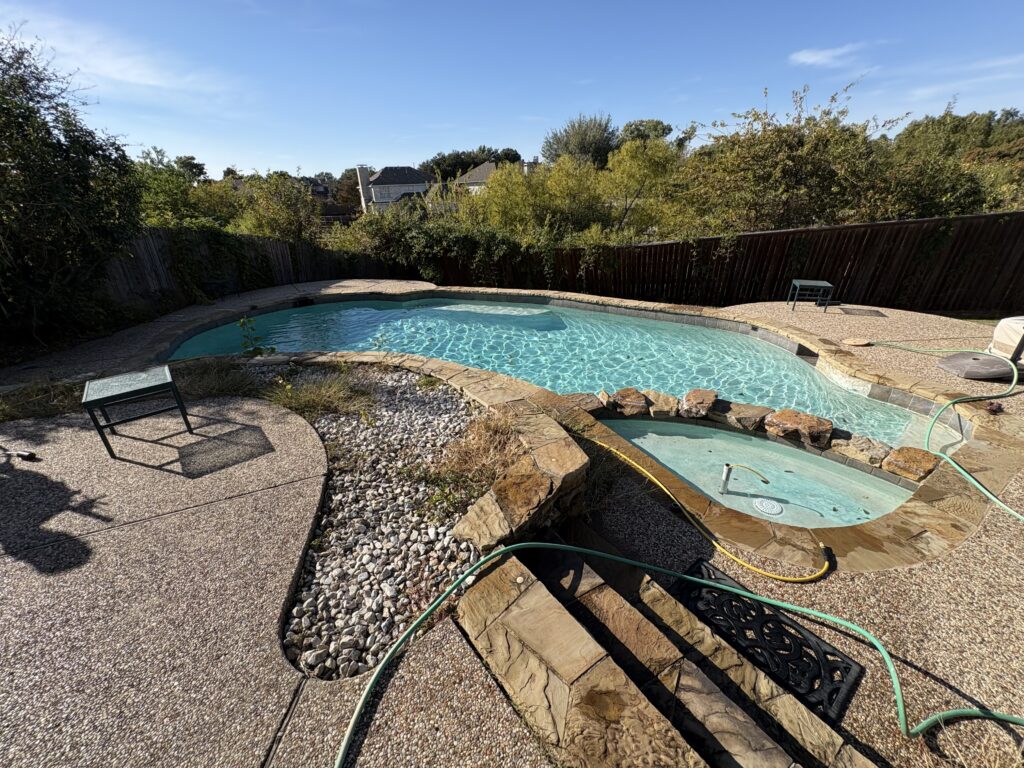
Even when you can’t see the leak, you might notice:
Water Level Patterns
Around the Pool
Equipment Area
Water Chemistry
Hidden leaks are hidden for a reason. They’re located:
Even if you could access these areas, you’d need to know exactly where to look. Guessing leads to unnecessary excavation, deck damage, and wasted money.
Professional leak detection uses specialized equipment you can’t buy at a pool store:
Pressure Testing
We isolate and pressurize individual plumbing lines — skimmer line, main drain line, return lines — to identify which line is losing pressure. This tells us which pipe is leaking without digging anything up.
Electronic Listening Equipment
Hydrophones and ground microphones detect the sound of water escaping underground. We can often pinpoint a leak’s location within inches.
Dye Testing
With the pump off and water still, we apply dye at suspected leak points. If there’s a leak, the dye gets pulled into it visibly. This works for cracks, fitting leaks, and skimmer separations.
Systematic Process of Elimination
We check every potential leak point methodically:
This process finds leaks that homeowners searching randomly would never locate.
Every day a hidden leak continues:
A leak detection today can prevent $3,000+ in damage next year.
If your pool is losing water and you can’t find the source:
Don’t start digging up your deck or yard hoping to find it. Professional detection costs a fraction of exploratory demolition — and actually finds the leak.
We detect and repair leaks in all inground pool types:
—
Mr. Pool Leak Repair serves Dallas, Plano, Frisco, McKinney, Allen, The Colony, Carrollton, Richardson, Southlake, Fort Worth, and communities throughout the DFW metroplex.
Ready to fix your leak for good?
Call 214-972-3330 or contact us online to schedule your leak detection.
Regular maintenance is a crucial aspect of owning a swimming pool, and having a comprehensive…
You may be wondering if you have a swimming pool leak if you notice that…
You may have noticed that the water level in your pool was low when you…
Leaks in the pool can be annoying, especially if you don't understand where they are…
Swimming pool leak detection is an essential aspect of pool maintenance. Leaks in your pool…
Commercial pools are more than just giant swimming holes—they’re major investments and vital attractions for…