Most of the pool cracks I look at in North Texas fall somewhere between “leave it alone” and “get it fixed this month,” and the hard part for a homeowner is knowing which end you’re on. From a lawn chair, a web of fine lines in old plaster and a crack running through the shell at the deep end can look about the same. They’re very different problems, though, and a repair that works fine on one will fail on the other.
We’ve found and fixed more than 20,000 leaks around Dallas-Fort Worth, and we regularly get called out to crack repairs somebody else made that didn’t hold.
What Causes Pool Cracks in North Texas
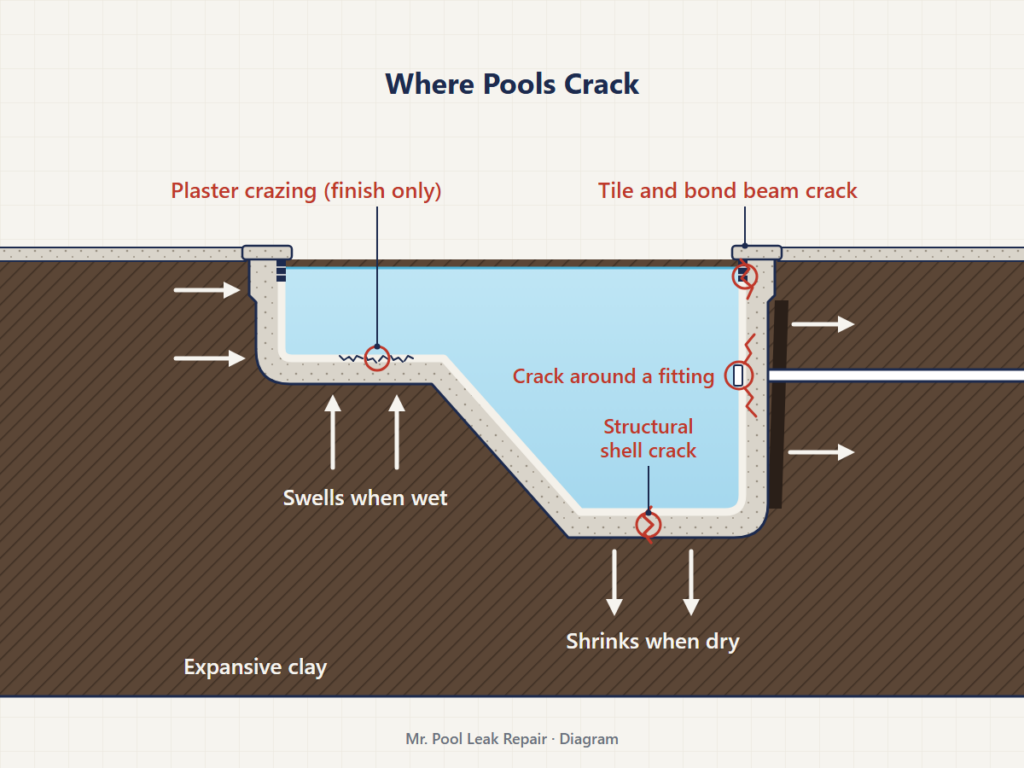
A gunite pool is a stiff concrete bowl. Across most of Collin and Dallas County, the ground it sits in is expansive clay, the black clay that swells when it’s wet and shrinks when it dries. After a week of spring rain it pushes up and out against the shell. By August it’s shrunk back and split open in the yard, and parts of the pool have less support than they had in April.
The Texas Department of Licensing and Regulation’s technical bulletin on foundations over expansive soils describes the same thing for houses: wet shrink-swell soil heaves and lifts the building, and dry soil gives way and lets it settle. A pool gets that push and pull every year, and a concrete shell can’t bend with it.
The movement is almost never even. Steps and benches sit shallower in the clay than the deep end, so the clay pushes on them differently. When one part of the pool drops or lifts a little more than the rest, the concrete cracks where the stress collects, usually at a corner, a step, the floor at one end, or the edge of a fitting.
A leak makes all of this worse. Water escaping from a fitting or an underground line soaks one patch of clay and not the rest, so one side swells while the other doesn’t. Leave a small leak running for a summer or two and it can turn into a structural crack.
The Kinds of Pool Cracks We Find
Crazing and Check Cracks in the Plaster
These are the fine, shallow lines that make a map or spider-web pattern across the plaster. We see them most on older plaster, after a replaster, and in pools where the water chemistry has run off balance for a while.
Crazing lives in the finish coat only. It doesn’t leak, and there’s nothing structural to fix, so most people leave it until the next replaster. The one thing I’d look for is a single longer, straighter line running through the web, since that can be a shell crack showing through from underneath.
Single Surface Cracks
A surface crack is one thin line that stays in the plaster or pebble finish and doesn’t reach the gunite. They turn up around steps, near the main drain, and where the plaster’s been patched before. Plenty of them are harmless, but some are the top of a structural crack that hasn’t opened all the way yet, and you can’t tell which from the deck.
To find out, we put a little dye right at the crack in still water and watch. If water’s getting out through it, you can see the dye drift into the line and vanish, where on a dry crack it just hangs there and spreads. A dry crack in the finish gets a plaster patch, and one that takes dye gets treated as structural.
Structural Cracks in the Gunite Shell
These go through the plaster and into the concrete shell, and they’re the ones that leak. They’re usually longer than a surface crack and often run diagonally off a corner, a step, or the skimmer, and many are wider at one end than the other. Where it sits matters, since a crack across the floor at the deep end and one across the shallow end point to different parts of the pool moving.
From the field · Stonebridge Ranch, McKinney
The Okafors called us about a hairline crack at the deep end of their Stonebridge Ranch pool, one they’d been watching for a couple of years. The first summer it was easy to ignore. After the second dry summer it had stepped, with one side sitting a little lower than the other, and they were topping off more often.
Dye went straight into it. Our level readings around the coping showed the deep end had dropped below the shallow end, and the pressure test cleared every line, so the crack was the whole leak. A licensed Texas Professional Engineer reviewed the readings, we set steel piers under the deep end, and then we stapled the crack and patched the plaster over it.
Our McKinney pool leak detection page covers how we test pools in that part of Collin County.
Cracks at the Tile Line and Bond Beam
The bond beam is the thick, reinforced top edge of the pool wall that the waterline tile and coping sit on. Tile is rigid, so it’s often the first place movement shows: a row of tiles cracking or popping off along one side, or tile that sounds hollow when I knock on it with a knuckle. A crack in the beam itself usually comes with loose coping or a gap opening between the coping and the deck.
Beam and tile damage nearly always points to movement, either the shell shifting or the deck pushing on the beam as the clay swells. New tile set on a beam that’s still cracking tends to pop off again, so the beam gets repaired first, under an engineer-reviewed plan if the pool is moving.
Cracks Around Skimmers, Returns, and Lights
Every hole through the shell is a weak spot: the skimmer throat, each return fitting, the light niche, the main drain. When the deck and the shell move a little differently, the stress ends up there. You might see a crack circling a return, a diagonal line running off a corner of the skimmer, or a gap where the skimmer throat meets the wall. These often leak, and dye shows it fast.
The fix is a seal repair at the fitting, or a new skimmer if the old one has pulled too far away to reseal. Those seal repairs carry our 3-year seal warranty. If the crack keeps going past the fitting and out into the wall, we treat it as a shell crack.
How to Tell if a Pool Crack Is Structural
Before anybody comes out, you can check a few things from the deck:
- One line, or a web of fine lines? A web is almost always the plaster.
- Look for one side of the crack sitting higher than the other, or one end noticeably wider.
- A crack that starts at a corner, a step, or a fitting and runs off at an angle deserves a closer look.
- Watch for tile popping along that same side, or a gap opening at the coping.
- Does the water line sit higher on the tile at one end than the other?
Then see whether the pool’s losing water at all with the 24-Hour Tape Test. Shut the autofill off, stick a strip of tape on the tile at the water line, and mark where the water sits. Leave it for 24 hours with no water added, then look again. Summer evaporation can take about a quarter inch a day, so a bigger drop than that likely means a leak.
When we come out, we start with dye at the crack. Then we take elevation readings around the pool with a digital level and plot them on a diagram, which shows whether the pool is sinking, lifting, or twisting, and by how much. We also plug and pressure test every plumbing line, because the same soil movement that cracks a shell can crack the pipe running out to the equipment. Our page on whether a pool crack is leaking goes further into both tests.
Get someone out to look at it if a crack takes dye, has grown since you first noticed it, or has one side stepped down, or if the tape test shows more loss than evaporation.
Which Crack Repairs Actually Hold
Staples are the standard repair for a structural crack. Slots get cut across the crack, the staples are set into them, and the area gets a plaster patch. They hold the two sides of a crack together well, but they can’t stop the ground, and if the clay under the pool is still moving, the crack opens again beside or through the staples. We’ve been called to pools that had several rounds of staples put in over the years.
The repair depends on whether the shell is still moving, and if it is, we stabilize it first. Steel piers are driven down through the clay that swells and shrinks to stable ground below it, so the pool’s weight rests on the piers instead of riding the seasons. A licensed Texas Professional Engineer works with us on the plan, and then the crack is stapled and patched. Our pool foundation repair page walks through the pier process, and the pool crack repair page goes deeper on each crack type and staple method.
Our lifetime structural pier warranty runs for the normal life of the pool structure and covers the pier work and foundation-related cracks repaired with staples and a plaster patch. On a pier job you can also add our 5-year full pool leak warranty, which is only available as an upgrade with a structural pier repair. Crack repairs done without pier work, staple-only repairs included, don’t carry the lifetime warranty. We’ll still do a staple-only repair if you want it, after we tell you what to expect. Full terms and exclusions are on our warranty page.
If the readings show the pool isn’t moving and the crack is old and stable, sealing it with hydraulic cement or an epoxy injection and patching the finish can hold without piers. Putty smeared over a crack that’s still moving might slow a small leak for a while, and that’s about all.
Replastering over an undiagnosed crack doesn’t hold either. One of the most expensive mistakes we see is a pool that got staples and fresh plaster while it was still moving, and a few seasons later the same crack came back through the new finish.
Some of the Preston Hollow pools we work on are old enough to carry a patch or two from earlier crack repairs, so we test the old repairs along with the new crack. Our Dallas pool leak detection page has more on those.
What Structural Pool Crack Repair Costs
HomeAdvisor’s pool repair cost guide puts small cracks in a gunite or concrete pool at about $75 per linear foot and resurfacing a concrete pool at $10,000–$20,000.
According to Fixr’s pool leak repair cost guide, most people spend $325–$5,000 on pool crack repairs, and it notes that a major crack running down to the beam can be difficult and expensive to fix.
Those are national numbers for crack repair, and they won’t tell you whether your pool also needs piers. On our jobs, repairs average about $2,500. Pier work is priced by how many piers the pool needs and what gets repaired along with it, so we don’t quote it until we’ve taken readings. You get a same-day written diagnostic report and repair estimate, and you’ll know the price before any work starts.
What to Do When You Find a Crack
- Take a photo with a tape measure lying next to the crack, and take another every couple of weeks. If it’s getting longer or wider, it’s still moving.
- Run the tape test above.
- Hold off on a replaster or new tile until someone has figured out why the crack is there.
- Keep roof and yard water draining away from the deck, and don’t let a known leak keep running.
The state bulletin above points to drainage and sprinkler habits among the things that keep soil moisture from swinging. If you’re sorting out other symptoms along with a crack, the Pool Leak Knowledge Hub is organized by what the pool is doing.
Frequently Asked Questions
Can a cracked pool be fixed?
Most cracked pools can be repaired without tearing anything out. Finish cracks get a plaster patch, cracks at fittings get resealed, and structural shell cracks get sealed or stapled, then patched. If the shell is still moving, piers go in first so the crack repair has stable ground under it. A pool that’s truly past saving is rare.
Do all pool cracks leak?
Crazing and cracks that stay in the plaster finish don’t leak. Cracks that go through the gunite shell, and cracks around skimmers, returns, lights, and drains, often do. A dye test at the crack shows whether water is moving through it, and the 24-Hour Tape Test tells you whether the pool is losing more than evaporation would take.
How do you repair a crack in a gunite pool?
We confirm the leak with dye and take level readings to see whether the shell is moving. A crack on a stable shell gets sealed with hydraulic cement or an epoxy injection, and the finish is patched over it. If the pool is moving, a licensed Texas Professional Engineer reviews the plan, steel piers go in, and then the crack is stapled and patched.
Will a pool crack come back after it’s repaired?
It can if the soil under the pool keeps moving, which is why staples alone often don’t last on a shell that’s shifting. When piers stabilize the pool first, the pier work and the foundation-related crack repair are covered by our lifetime structural pier warranty for the normal life of the pool structure.
Dealing with a pool leak?
Call today to learn more about how we can help you stop your cracked pool from leaking.
Mr. Pool Leak Repair serves Dallas, Plano, Frisco, McKinney, Allen, Southlake, Fort Worth, and communities throughout the DFW metroplex.


