Nobody in Dallas-Fort Worth closes a pool for winter the way they do up north. The water stays in and the pump keeps running. Pool freeze protection only has to do its job a handful of nights a year, but if it misses one of them you can wake up to a split pipe at the equipment pad. February 2021 showed plenty of North Texas homeowners what happens when it can’t, and we’re still finding pool plumbing that cracked that week.
Why the Plumbing Freezes Before the Pool Does
In a DFW winter the pool itself almost never freezes deep enough to hurt anything. The trouble is the water sitting in the open air at the pad, in the pipe, valves, pump, filter, and heater. Water expands when it freezes, and a PVC fitting has nowhere to give.
Texas A&M AgriLife Extension’s winter weather guidance says water pipes can freeze and burst at 20 degrees or below, and it lists swimming pool supply lines among the pipes especially likely to freeze. It also says pipes with northern exposure are at higher risk, which fits many equipment pads.
How Pool Freeze Protection Works on Your Controller
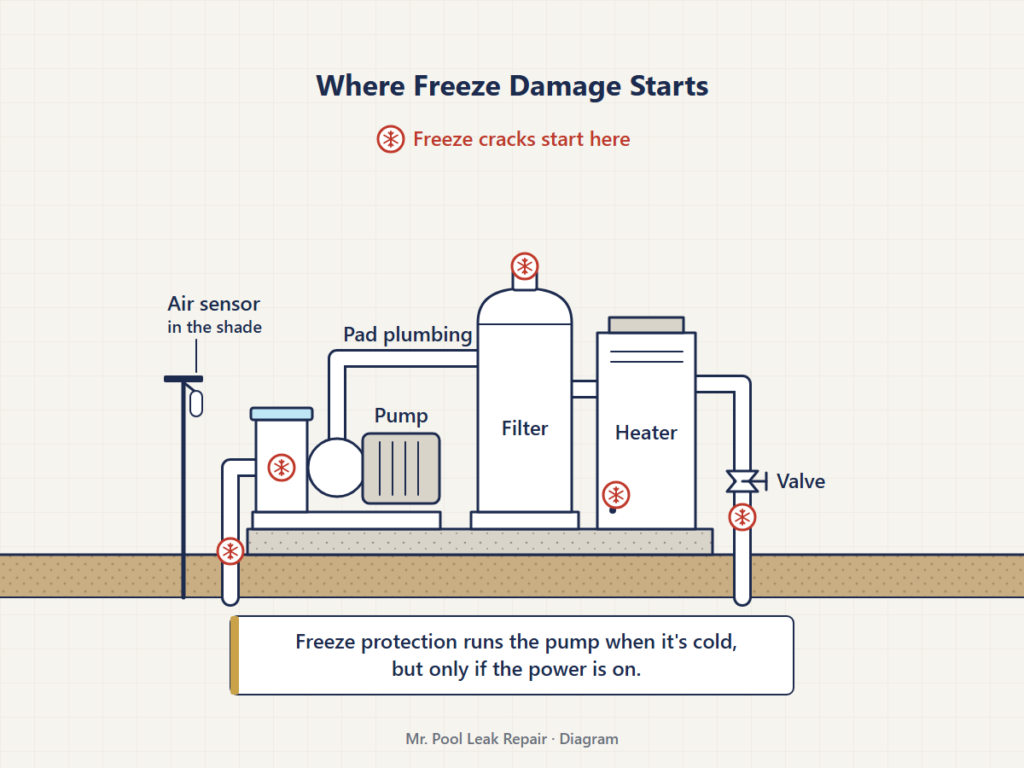
On an automated pool, freeze protection lives in the controller and works off an air temperature sensor near the equipment. Pentair’s manual for its SunTouch controller lays it out plainly. When the sensor reads below 36°F, the controller turns on the filter pump and runs every circuit assigned freeze protection. With a spa, it also switches the valves between pool and spa so water keeps moving in both. Other brands have their own settings.
Before winter, I’d look at three settings:
- Make sure freeze protection is turned on. I’ve opened more than one panel where it never was.
- The Pentair manual says the air sensor goes in the shade, out in the open air.
- Check which circuits are assigned, because a waterfall or spillover that isn’t on the list sits with still water in its line all night.
No setting covers a power outage, though. Freeze protection is nothing more than the controller turning the pump on, and with the power out, neither one can run.
What Happened to Pool Plumbing in February 2021
The National Weather Service in Fort Worth logged 139 hours in a row at or below freezing at DFW Airport, from the evening of February 13 to noon on February 19, with a low of 2 below zero on the 16th. NOAA’s write-up on the Great Texas Freeze says nearly 10 million people were without power at the peak of the outages.
Freeze protection did its job until the power went out. Once the pumps stopped, the water sitting in the pad plumbing froze, and a lot of people didn’t know anything had cracked until the power came back and water sprayed out of the manifold.
Out in Ridglea and the rest of west Fort Worth, people were under a boil notice that week while the city chased hundreds of broken water mains, so the pool pad wasn’t high on anybody’s list. If your Fort Worth pool has lost more water since that winter, it’s worth a test.
What Cracks at the Equipment Pad
After a hard freeze I start at the pad and check these parts:
- Pad plumbing and the manifold. PVC tends to split lengthwise or crack at a valve body, often where it comes out of the ground.
- The pump. The pump pot and housing hold water, and a cracked housing or lid leaks once it thaws.
- The filter, both the tank and the valve on top.
- The heater, which holds water inside and has its own drain plugs.
- Exposed pipe away from the pad, like a line up to a raised spa or waterfall.
A frozen crack often won’t show itself at first. Pentair’s winter storm guidance points out that cracks in frozen pipes won’t leak until they start to thaw. If the pad’s wet afterward, our page on an equipment pad that’s always wet explains how to read it, and we check every union, valve, and housing during equipment leak detection.
What to Do Before a Hard Freeze
When the forecast shows a night in the low 20s, or a few days in a row below freezing:
- Check those controller settings, and compare the controller’s air reading to your weather app.
- Run the pump all night instead of trusting the schedule. Pentair’s storm guidance says to keep pumps circulating in freezing temperatures, since moving water is less likely to freeze.
- Wrap exposed pipe at the pad with foam sleeves or insulation. It’s cheap, at least until the day before a storm when the shelves are empty.
- Find your pool breakers now, in daylight.
If the Power Goes Out During a Freeze
If the power drops on a freezing night and isn’t coming back soon, you’ve got a call to make: wait it out or drain the equipment. Pentair’s storm guidance lays out the draining:
- Turn off all the breakers to the pool.
- Take off the pump pot lid and the filter lid.
- Open as many valves as you can, including the air relief valve on the filter.
- Pull the pump pot plug, the pump volute plug, and the drain plugs next to the heater.
Put the plugs in a zip bag on top of the pump so they’re not lost in the grass. For a short outage on a night right around freezing, I’d usually wait it out, but if it’s heading into a second night in the teens, I’d drain the pad. Priming the pump again is far less trouble than a cracked filter tank.
When the power comes back, walk the pad before you flip the breakers. If anything’s split or cracked, leave it off and call us.
Frozen Pool Pipes That Leak Months Later
Some freeze cracks don’t leak for a long time. A hairline crack in an elbow just below ground can stay tight, then open as the ground shifts and the pump pushes on it every day. Our underground pool pipe break page covers the other ways those lines fail.
From the field · Timarron, Southlake
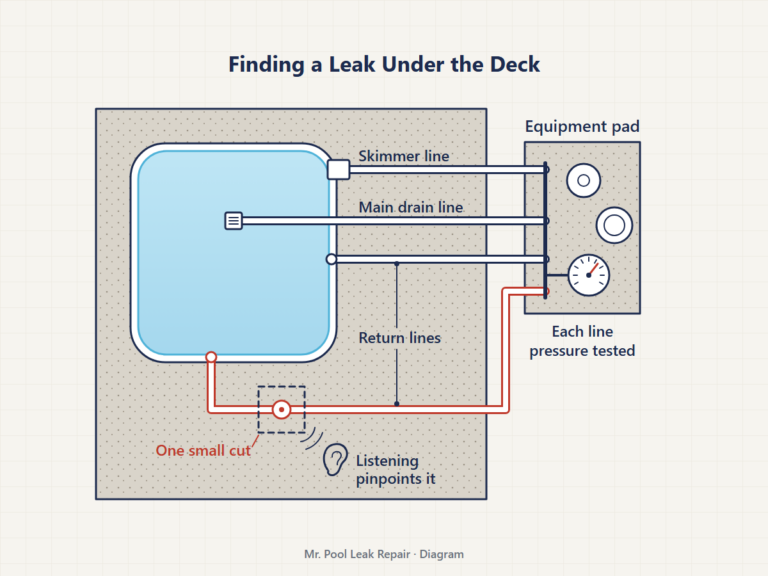
The February 2021 freeze had already split the manifold on the Abernathys’ pool in Timarron, and it had been replaced. Two springs later, in April, the pool started dropping faster than it should, and only on days the pump ran. The pad was dry. We plugged and pressure tested each line, and one return line lost pressure while the rest held. On the listening equipment, the sound peaked a couple of feet from the pad, at the elbow where the pipe turns down into the ground. We opened a small spot in the deck, replaced the elbow, and patched the concrete after the retest held.
Watch for a pool that drops faster with the pump running, ground near the pad that stays wet without rain, or air in the pump basket. Our Southlake pool leak detection visits test every line the way we did at the Abernathys’. The fix is usually a single opening and a new section of pipe, as with most underground pool pipe repair jobs, and that section carries our 3-year pipe warranty. Our warranties don’t cover weather damage or equipment leaks, so keep up the freeze prep.
When to Call
Anything at the pad that drips after a thaw, a pump that won’t hold prime, or a pool that’s dropping faster than before means it’s time to have us out. The 24-Hour Tape Test settles whether it’s dropping. Switch the autofill off, stick a strip of tape at the water line and mark it, and go a day without adding water before you look. In summer a pool can lose about a quarter inch a day to evaporation, and less in winter. Lose more than that for the season and you likely have a leak. We’ll have a written diagnostic report and repair estimate to you the same day we test. The number’s 214-972-3330.
Frequently Asked Questions
Should I run my pool pump in the winter?
In North Texas you should, because the pool stays open and the water still needs to circulate. On nights near freezing, let freeze protection run it or run it all night yourself. Pentair’s storm guidance says to keep pumps circulating in freezing weather, since moving water is less likely to freeze.
At what temperature will pool pipes freeze?
Texas A&M AgriLife Extension says water pipes can freeze and burst at 20 degrees or below, and it names pool supply lines among the most likely to freeze. Pipe at the pad can be at risk sooner if the water’s sitting still. Controllers start well ahead of that, and Pentair’s SunTouch kicks on below 36°F.
How do I keep pool pipes from freezing?
Make sure freeze protection is on with every water circuit assigned, run the pump all night before a hard freeze, and wrap above-ground pipe at the pad. If the power’s out for a long stretch in deep cold, turn off the breakers and drain the pump, filter, and heater.
Does pool pump freeze protection work if the power goes out?
Freeze protection is the controller turning on the pump when its air sensor reads cold, so with the power out, neither one can do anything. In a long outage, draining the equipment is the protection you’ve got left. Pentair’s storm guidance walks through it: breakers off, lids off, valves open, and the drain plugs out.
Dealing with a pool leak?
Call today to learn more about how we can help you stop your pool from leaking after a freeze.
Mr. Pool Leak Repair serves Dallas, Plano, Frisco, McKinney, Allen, Southlake, Fort Worth, and communities throughout the DFW metroplex.