Dealing with a pool leak?
Call Mr. Pool Leak Repair at 214-972-3330 for professional detection and repair backed by our 3-year no-leak warranty. We get your pool to stop leaking—100% guaranteed.

Every pool loses some water. Between evaporation, splashing, and backwash, it’s completely normal to see water levels drop. But how do you know when water loss crosses the line from routine to concerning? In this article, we will be looking at eight signs your pool has a leak.
Pool leaks often start small and gradually worsen over time. The sooner you catch them, the less expensive they are to repair—and the less damage they cause to your pool structure and surrounding property.
1. You’re Adding Water More Than Once a Week
This is often the first sign pool owners notice. While evaporation rates vary based on temperature, humidity, and wind, most pools lose about 1/4 inch of water per day during hot summer months. If you’re adding water more than once a week, or if you’re losing more than 2 inches per week, something beyond evaporation is likely happening.
Pro tip: Keep a log of when you add water and how much. This information helps leak detection professionals understand the severity of the problem.
2. Your Water Bill Has Spiked
If your pool has an auto-fill device, you might not notice daily water loss—but your water bill will tell the story. A sudden, unexplained increase in your water bill often indicates a leak, especially if your household water usage hasn’t otherwise changed.
A pinhole-sized leak can waste nearly 1,000 gallons of water per day. That’s about four times the daily water consumption of an average family of four. Over a month, that adds up to a significant—and expensive—problem.
3. You See Wet Spots Around the Pool
Wet or soggy areas in your yard near the pool, especially in spots that should be dry, can indicate a leak. Pay particular attention to:
- Areas around the pool equipment pad
- Spots near the pool’s plumbing lines
- Ground between the pool and the equipment
If the same areas are consistently wet even during dry weather, underground plumbing or the pool shell itself may be leaking.
4. Air Bubbles in the Return Lines
When you see air bubbles (or dirt) coming out of the return jets while the pump is running, you likely have a leak on the suction side of your plumbing system. This means air is being drawn into the pipes somewhere between the pool and the pump.
These bubbles are often accompanied by gurgling sounds. You might also notice air repeatedly building up inside the filter tank or visible in the pump basket if you have a clear lid.
5. Cracks in the Pool Deck or Coping
Visible cracks in your pool deck, coping, or the pool shell itself are red flags. While not every crack indicates a leak, cracks often allow water to escape or can be symptoms of the ground settling due to water erosion beneath the surface.
In North Texas, expansive clay soil makes this especially common. As water from a leak saturates the soil, it expands and shifts, causing additional cracking and damage. It’s a cycle that accelerates over time.
6. Difficulty Maintaining Chemical Balance
Pool water that’s leaking out takes the chemicals with it. If you’re constantly fighting to maintain proper pH, chlorine, or alkalinity levels despite regular treatment, a leak may be the culprit.
Inconsistent chemical levels also create ideal conditions for algae growth. If you’re battling algae despite proper treatment, water loss could be part of the problem.
7. Equipment Running Constantly or Losing Prime
When your pool is leaking, the pump and filtration system work harder to maintain water levels. You might notice:
- The pump running more frequently than usual
- The pump losing prime (requiring priming to restart)
- Increased electricity costs
- Equipment showing unusual wear
If your pump seems to be struggling or cycling on and off more often, it could be compensating for water loss somewhere in the system.
8. Changes in Your Landscaping
Leaking pool water doesn’t just disappear—it goes somewhere. Look for these landscaping clues:
- Grass that’s unusually green near the pool (it’s getting extra water)
- Brown patches where grass has died from chlorinated water exposure
- Erosion or sunken areas near the pool or equipment
- Plants near the pool that appear to be struggling
These changes often indicate where water is escaping, which can help professionals locate the leak more quickly.

How to Confirm You Have a Leak: The Bucket Test
Before calling a professional, you can perform a simple test to confirm whether you’re dealing with a leak or just normal evaporation:
- Fill a 5-gallon bucket with pool water and set it on the first or second step of your pool (submerged about 5 inches).
- Mark the water level inside the bucket.
- Mark the water level on the outside of the bucket (the pool water level).
- Turn off auto-fill devices and leave the pump running normally.
- Wait 24 hours.
- Compare the water levels.
If the pool lost significantly more water than the bucket, you have a leak. If both levels dropped by the same amount, you’re likely just experiencing evaporation.
When to Call a Professional
You should contact a pool leak detection specialist if:
- The bucket test confirms a leak
- You’re losing more than 1/4 inch of water per day consistently
- You notice multiple warning signs from this list
- Water loss continues even in cooler weather
- You’ve tried to locate the leak yourself without success
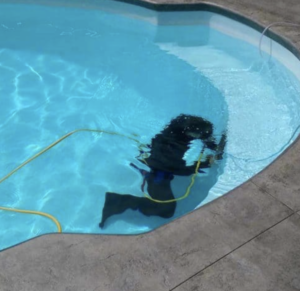
Professional leak detection uses specialized electronic equipment to pinpoint leaks precisely—in the pool shell, plumbing, equipment, or fittings—without unnecessary digging or damage. This accuracy saves time, money, and frustration compared to guessing.
The Cost of Waiting
Small leaks become big problems when left unaddressed:
- Structural damage: Water escaping from your pool can erode the soil supporting your pool and deck, causing cracks, settling, and expensive structural repairs.
- Increased repair costs: What starts as a simple fix can escalate into major plumbing or shell repair if ignored.
- Higher utility bills: You’re paying for water and chemicals that are literally going down the drain.
- Foundation concerns: In areas with expansive clay soil, leaking pool water can affect your home’s foundation by oversaturating the soil.
Protect Your Investment
Your pool is a significant investment—and a valuable part of your home. If you’re seeing any of these warning signs, don’t wait for the problem to get worse.
Call Mr. Pool Leak Repair at 214-972-3330 to schedule a professional leak detection inspection. Our certified technicians use state-of-the-art equipment to find leaks accurately, and we’ll provide you with clear repair options to get your pool back in shape.
Mr. Pool Leak Repair has served the Dallas-Fort Worth metroplex for over 13 years, helping homeowners protect their pools from leaks caused by North Texas’s challenging expansive clay soil.
We get your pool to stop leaking—100% guaranteed. Every repair is backed by our 3-year no-leak warranty because we do the job right the first time.
What We Do:
- Leak Detection – Professional electronic detection to pinpoint leaks accurately
- Structural Crack Repair – Injection foam sealing for lasting repairs
- Skimmer & Return Repair – Fixing the most common leak points
- Underground Plumbing Repair – Locating and fixing buried pipe leaks
- Dye Testing – Visual confirmation of leak locations
- Pool Remodeling – Plaster, tile, coping, and concrete removal/replacement
Why Choose Us:
- 13+ years serving Dallas-Fort Worth
- 400+ five-star reviews
- Transparent pricing with written estimates
- Discounts for veterans, teachers, law enforcement & autism community
Ready to fix your leak for good? Call 214-972-3330 or contact us online to schedule your leak detection.