Every pool in North Texas loses water to the air, and most owners have a decent feel for what’s normal in July, less so for the rest of the year. The pool evaporation rate here swings a lot from one season to the next, so a drop that’s perfectly normal in August can mean a leak in November. I’ve stood at plenty of equipment pads in October hearing “it’s just the heat,” when most of the heat left a month ago.
If you only want the short answer on whether evaporation is normal at all, see our quick page on pool evaporation. This one goes month by month.
What a Normal Pool Evaporation Rate Looks Like in DFW
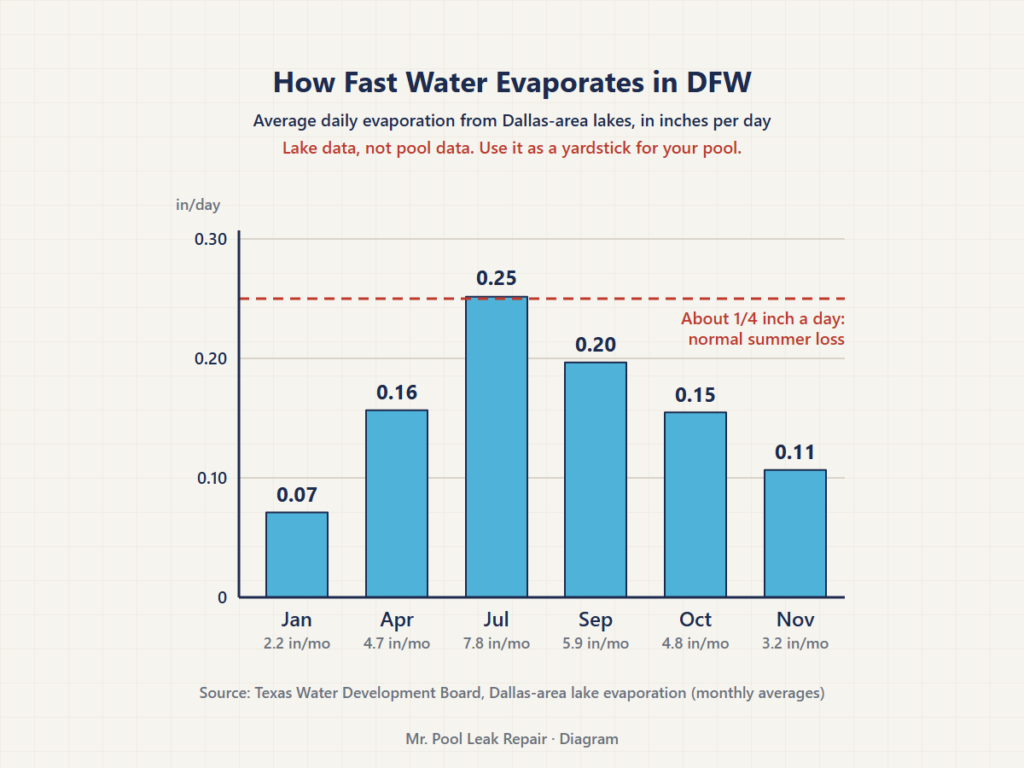
Nobody has a meter in the backyard that reads evaporation, but the state tracks it for lakes. The Texas Water Development Board’s lake evaporation records go back to 1954 and are broken out month by month for each block of the state. Here’s what they show for the block that takes in Dallas, averaged over all those years. The per-day column is my own rough math, the monthly total divided by the days in the month.
| Month | Average lake evaporation for the month | Roughly per day |
|---|---|---|
| January | 2.2 inches | a little under 0.1 inch |
| April | 4.7 inches | about 0.15 inch |
| July | 7.8 inches | about 0.25 inch |
| September | 5.9 inches | about 0.2 inch |
| October | 4.8 inches | about 0.15 inch |
| November | 3.2 inches | about 0.1 inch |
July lands on the quarter inch a day we tell people to expect in summer, and it falls off fast after that. An October day takes roughly 0.15 inch, and a January day takes less than a third of what July does.
A lake isn’t a backyard pool, of course. A pool in full sun with a waterfall or a heater can run a little higher than these averages, and a shaded pool that stays covered will run lower, so treat the table as a yardstick. The neighboring blocks that take in Plano and Fort Worth come out close to the same.
How Much Water a Pool Loses a Day in Summer
From June through August, a pool can lose about a quarter inch a day to evaporation. On a pool about 15 by 30 feet, each inch of water is roughly 280 gallons, so a quarter inch is about 70 gallons a day going up into the air. That’s normal, and there’s nothing to fix.
A brutal summer can push past it. July 2022 shows up in those same state records at about 10 inches for the month, which works out closer to a third of an inch a day. So if your tape shows a hair over a quarter inch after a windy week of triple digits, run the test again before you start worrying. Half an inch or a full inch a day is more than weather can explain, and our page on a pool losing an inch of water a day goes through where that water usually ends up.
Summer is also when a small leak hides best. A skimmer joint letting go of a tenth of an inch a day disappears into normal July evaporation, and with an autofill running you won’t see the level move at all. The water bill is usually the first sign.
Fall: When the Water Loss Should Slow Down
September still runs warm, but by October the days are shorter and evaporation backs off. You should be adding less water each week than you did in summer, and a pool that loses as much in October as it did in July is one of the clearest leak signs there is.
From the field · Willow Bend, Plano
The Brennans in Willow Bend ran into exactly that. By late October they’d been keeping a strip of tape on the tile for weeks. They’d lost about a quarter inch a day in July and blamed the heat, but the pool kept dropping a quarter inch a day after the weather cooled off.
We plugged and pressure tested each line, and the gauge held on every one. At the skimmer, the dye slid into a thin gap at the throat where the skimmer had pulled away from the shell, and the deck on that side had settled a little over the summer. We resealed the throat in one visit, and it’s held since.
The black clay under most of Collin County dries out and shrinks by late summer, and the deck and the pipes settle along with it. A skimmer joint or a pipe fitting that was tight in the spring can open up in August, which happens to be when evaporation is high enough to cover for it. When evaporation drops off in the fall, that leak is still running, and that’s often when people first notice it.
For pools up there, see our Plano pool leak detection page.
You may see steam coming off the water on a cool October morning. The pool’s still holding summer’s warmth and giving water to the air, so the loss won’t stop overnight, but it should be noticeably smaller than July’s. By November, the lake numbers work out to about a tenth of an inch a day.
Pool Losing Water in Winter
Winter’s the easiest season to read. On the state’s lake numbers, a January day takes less than a tenth of an inch, so an unheated pool shouldn’t drop much over a week without rain. If you’re reaching for the hose every week in December or January, you’ve probably got a leak.
Rain adds water and covers up a loss, so don’t measure after a storm. A heated spa or pool will also lose more than the table shows (more on why below), so if the heater ran all weekend, check again during a week it’s off.
Old freeze damage tends to show up now, too. In Fort Worth we still find pool lines that cracked in the February 2021 freeze and have been leaking a little at a time ever since. In summer that loss gets blamed on the heat, but in January it’s easy to spot. If that sounds like your pool, our Fort Worth pool leak detection page explains how we test the lines out there.
Spring: Rain, Wet Clay, and the First Hot Weeks
Evaporation climbs back up in the spring. April’s lake average works out to about 0.15 inch a day, close to October, and by June you’re getting back toward summer numbers. Rain makes spring harder to read. A pool that catches a couple of inches in a wet week can look like it’s holding when it isn’t, so wait for a dry stretch before you trust any measurement.
The clay works in reverse this time of year. It swells back up as it soaks in rain, so a joint or a crack that opened in August can partly close by April, and some leaks seem to come and go with the seasons. If your pool held fine all spring and started dropping again in late summer, write down the dates. That history helps when we come out.
Once school lets out, splash-out and extra backwashing take water too, which is one more reason to measure on a day nobody swims.
What Wind, Heat, and a Waterfall Do to the Numbers
The EPA’s WaterSense guide to pool water efficiency says the evaporation rate depends on temperature, humidity, and wind speed, and that warmer water evaporates more quickly, so heated pools lose even more than unheated ones. A dry, gusty afternoon after a front blows through can pull a very different amount out of a pool than a muggy, still afternoon in August, and a spa you keep at 100 degrees all winter will lose more than the pool beside it.
Water features are the one people forget about. A waterfall, a sheer descent, or a bubbler on the tanning ledge throws water around, and the same EPA guide says that turbulence increases evaporation and can lose water to wind and splashing. It suggests running features only when you’re using the pool, or putting them on a timer that shuts them off at night. A windbreak like a fence or shrubs and a little more shade help too, though the guide calls a pool cover the most effective way to cut evaporation.
A water feature can also be the leak, since it has its own plumbing. Run the tape test once with the feature off and once with it running. If the pool only drops too fast while the feature runs, and by more than a little spray would explain, the feature’s line or the basin behind it moves up the suspect list.
Check It Yourself With the 24-Hour Tape Test
You don’t need special tools for this one. The 24-Hour Tape Test goes like this:
- Turn off the autofill, or it’ll quietly top off the pool during the test and hide what you’re losing.
- Put a strip of tape on the tile or the side of the skimmer, right at the water line, and mark the level on it with a marker. Note the time.
- Don’t add any water for 24 hours. Skip swimming and backwashing, and shut off the waterfall or fountain if you can.
- Check the water against your mark. In summer, a pool can lose about a quarter inch a day to evaporation. If it dropped more than that, you likely have a leak.
In the cooler months, hold the pool to a lower bar. A quarter inch in a day in November is a July number in a month when the lake numbers run closer to a tenth, so compare your drop with the table above for whatever month you’re in. If you’re not sure, run it two days in a row.
To see your number in gallons, our pool leak calculator shows what an inch or two a day works out to for your pool’s size. It’s the closest thing we have to a pool evaporation calculator.
If you have an autofill, it’s worth shutting it off for a tape test every few months, and making one of those October. By then evaporation’s down and the clay has done its late-summer shrinking, so a leak stands out better than it does in summer.
When It’s Time to Call Us
Call us when the tape test comes in over the normal number for the season, or when the pool’s losing as much in fall or winter as it did in summer. Wet or soft ground near the pool or equipment pad, new cracks in the deck or tile, and air in the pump basket are worth a call too.
On a pool leak detection visit, we plug and pressure test each line one at a time, put dye at the fittings, skimmer, lights, and any cracks, and use listening equipment along a line that won’t hold pressure. We’re past 20,000 leaks found and fixed. You get a written diagnostic report and repair estimate the same day, and our repairs average about $2,500.
Frequently Asked Questions
Why is my pool losing water when the pump is off?
Evaporation doesn’t stop when the pump does, so some loss with the equipment off is normal. If the pool drops noticeably more with the pump off than with it running, that usually points to the shell, a fitting like the skimmer or a light, or a broken underground pipe that drains by gravity. Run the tape test, write down whether the pump was on or off, and tell us when you call. It helps us decide where to start.
Is it normal for a pool to lose water in winter?
Some loss is normal, but not much. In a North Texas January, the state’s lake evaporation numbers work out to under a tenth of an inch a day, so a dry week shouldn’t have you reaching for the hose. If you’re topping off every week in December or January, or the drop matches what you saw in summer, have it checked. A heated spa or pool will lose more, so test during a week the heater’s off.
Is there a pool evaporation calculator for my pool?
Any evaporation calculator is an estimate built on weather numbers, and your pool’s sun, wind, and water features change the answer. The tape test is more useful because it measures what your pool actually did over a day. Once you know the drop, our pool leak calculator turns inches into gallons a day for your pool’s size, so you can see how much water a leak is really costing you.
Does a pool cover stop evaporation?
A cover is the best tool you’ve got for it. The EPA’s pool water guide calls covers the most effective way to reduce evaporation and notes they only work when they’re on the pool. A cover won’t fix a leak, though. If the pool still drops about a quarter inch a day with a cover on most of the time, the water is going somewhere besides the air.
Dealing with a pool leak?
Call today to learn more about how we can help you stop your pool from losing water.
Mr. Pool Leak Repair serves Dallas, Plano, Frisco, McKinney, Allen, Southlake, Fort Worth, and communities throughout the DFW metroplex.


