Pool line repair usually comes up once the easy suspects have been ruled out. The water’s going somewhere you can’t see, the skimmers and lights check out, and somebody’s mentioned the pipes under the deck. Now you’re worried about the deck, because nobody wants a crew jackhammering a trench from the equipment pad to the pool on a guess. When a buried line breaks, we test each line on its own and listen for the break before we open the deck directly over it. On most jobs that means one small cut and a patch.
Where Your Pool Lines Run and Why They Break
A typical inground pool has somewhere between 4 and 8 separate plumbing runs between the shell and the equipment pad. Suction lines pull water from each skimmer and the main drain to the pump, and return lines push filtered water back to the jets in the pool wall. A spa, a waterfall, or an in-floor cleaning system adds more. Nearly all of it’s buried under the deck.
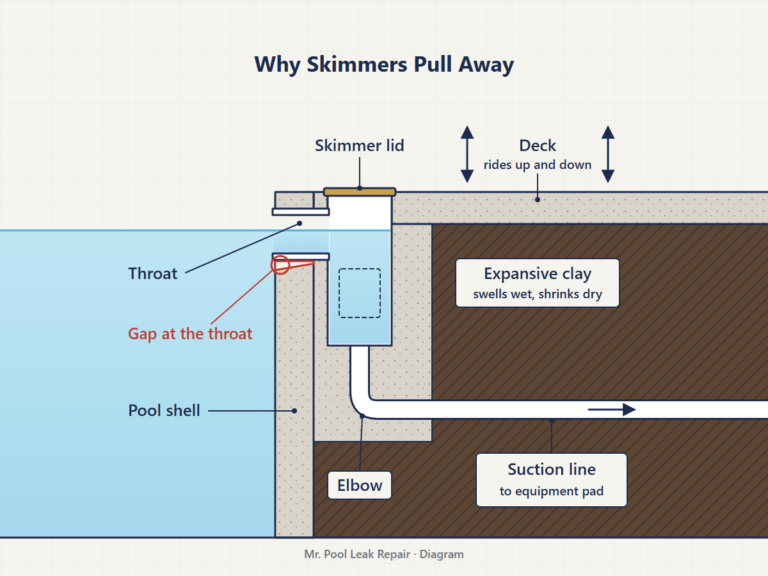
In Dallas, the ground around those pipes doesn’t sit still. Much of Dallas County is expansive clay, the black clay that swells when it’s wet and shrinks when it dries, and it pushes and pulls on everything buried in it. Every season works a pipe run a little more until a glued joint lets go or the pipe cracks at a bend, often where it’s tied to something that doesn’t move with the dirt, like the fitting at the shell or the riser at the equipment pad.
Tree roots get into old joints too, and some lines cracked in the February 2021 freeze and have been getting worse since. Our Dallas pool repair page covers what tends to fail in different parts of the city.
How Pool Line Repair Works, Step by Step
Every underground pipe job we do goes in the same order: figure out which line is leaking and where on that line the break is, and only then cut anything. You’ll see the same steps laid out on our underground pool pipe repair page.
Each line gets plugged and pressure tested
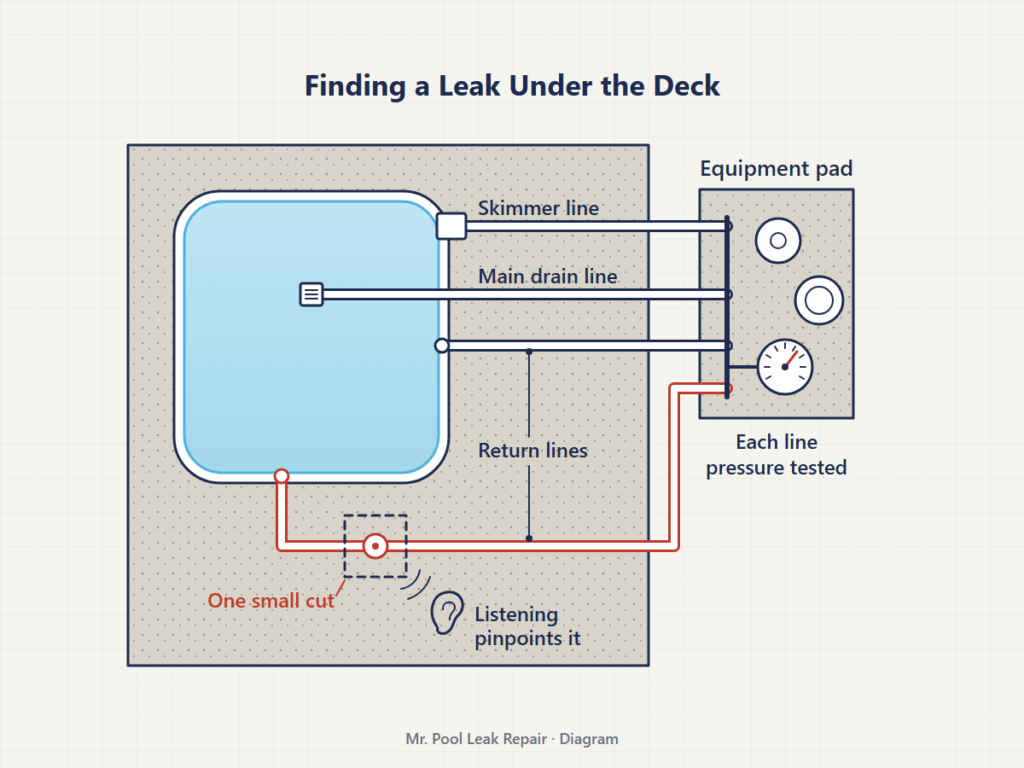
We start by looking over the pump, filter, valves, and unions at the pad, since there’s no sense testing buried pipe if the leak is a union dripping onto the slab. Then we put test plugs in the openings at the pool end of each line (skimmers, returns, main drain) and close valves to separate the suction side from the pressure side. The pool stays full the whole time.
We bring one line at a time up to pressure, usually 15 to 20 PSI, and watch the gauge for 15 to 20 minutes. If the line’s sound, the needle won’t budge the whole time. A cracked one bleeds down slowly, and a pipe that’s pulled completely apart can fall to zero almost as soon as we stop pumping. Our page on pressure testing pool lines explains what the readings mean.
Listening equipment finds the spot
A failed test only tells us which line is bad. To find the break itself, we keep the line under pressure and move listening equipment across the deck above the pipe run. Water or air escaping a cracked pipe makes a sound you’d never hear standing on the patio, but through the equipment it gets stronger as you close in and fades once you pass it. I want several passes before I trust a spot. Then it gets marked on the deck and written into the report you get that day.
It won’t catch every leak. A tiny crack under low pressure, or one under a lot of soil, can be too quiet, and when that happens we’ll say so and use other methods to confirm the spot. Our acoustic leak detection page has more on how it works.
One cut over the break
Once the spot’s marked, you get a written estimate covering the size of the dig, the repair, and how the surface gets put back. Then we open the deck at the mark, usually with a single saw cut or core drill, and dig down to the pipe. Some concrete does have to come up, so this isn’t a no-dig repair. Because the break’s already been found, though, we only open what it takes to reach it.
Repair, retest, and patch
We cut out the broken section and glue in new PVC with couplings on each end. If it failed at the joint where the line meets the shell, we repair that joint and reseal the connection. Then the line goes back on the gauge while the hole’s still open, because if something else on that line is leaking, we’d much rather find out before the concrete goes back down. Once it holds, we backfill and restore the deck.
One Small Cut Under Flagstone in Lakewood
From the field · Lakewood, Dallas
Over in Lakewood, the Harmons noticed their pool dropped faster on days the pump ran its long schedule, and that a few flagstones near the shallow end stayed dark after the rest of the patio dried. The equipment pad was dry. The skimmer and main drain lines held pressure, but the needle on one return line wouldn’t stay put. We walked that return run with the listening equipment, and the sound came up strongest under the damp stones, a few feet from the return fitting. We lifted those stones, sawed a single opening through the slab underneath, and found a glued joint that had pulled apart. New pipe went in, and after the line held on the retest we set the stones back. We never had to touch the rest of the patio.
Spot Repair or a Reroute
Most underground breaks are one bad spot on an otherwise sound line, and a spot repair at the mark is the simplest fix. Sometimes, though, the break sits under something you can’t reasonably dig through, like an outdoor kitchen or a big built-in planter. Other times the line is old enough to be failing in more than one place.
In those cases a reroute abandons the bad section and runs a new line, often above the deck, from the equipment pad back to the pool wall. A full line replacement digs out the whole run and puts in new pipe, which is more disruptive but deals with an aging line all at once. Pipe depth, what’s on top of it, and the line’s age all weigh in, and you’ll see the options in writing before you decide.
Epoxy Liners and No-Dig Pool Pipe Repair
If you’ve searched for swimming pool pipe repair without digging, you’ve run into epoxy lining, which fixes the pipe from the inside. There are epoxy lining products made for pool lines, and some companies sell kits that promise a fix with no digging. The way they describe it, the leaking line gets found with a pressure test, drained and dried, prepped on the inside, coated with epoxy, and pressure tested again once it cures. When the other choice is cutting into a deck, I can see why people ask about it. We don’t line pool pipes ourselves. When we find a cracked line, we cut out the bad section and replace it, or reroute the run if the old pipe is in bad shape.
What I’d want to know first is what the break looks like. NASSCO’s pipe rehabilitation guide, written by a trade group for sewer lines, says the old pipe has to be clear of obstructions and crushed or collapsed sections for a cured-in-place liner to install properly. And a coating inside a pipe doesn’t change what the clay is doing to the outside of it. If someone offers to line your pool lines, have them show you the test that found the break, and the pressure test afterward that proves the liner held.
What Swimming Pool Plumbing Repair Costs
Fixr’s pool leak repair cost guide puts underground pool pipe repair at $500 to $1,500 and notes that professionals may need to dig to make the repair. Replacing a pool pipe runs $1,000 to $5,000 in the same guide, depending on pipe size, how easy it is to get to, and how long the replacement takes.
On a real job, a shallow break under grass is a different day’s work from one under stamped concrete or flagstone, and a short cracked section isn’t the same job as a line that’s failing along its length. Across all the repairs we do, the average is about $2,500. You’ll get a written diagnostic report and repair estimate the same day we test, so you know the number before anything gets cut.
Suction-Side and Pressure-Side Leak Symptoms
Which side of the pump a leak is on changes what you’ll notice, and it tells us which lines to test first.
Suction side: skimmer and main drain lines
These lines are under vacuum while the pump runs, so a crack pulls air in instead of pushing water out. Watch for:
- Air in the pump basket. With the pump running it should be full of water, so air you can see through the clear lid is getting in somewhere.
- The returns keep spitting bubbles long after the pump starts.
- A pump that keeps losing prime or has gotten loud and rattly.
- More loss overnight or with the pump off, when water can drain out through a crack below the waterline.
Check the pump lid and o-ring first, since a cracked lid or dried-out o-ring causes the same air problems. If you’ve replaced those, or even the pump, and it still loses prime, read about a suction line pool leak before you buy another part.
Pressure side: return lines and water features
Return lines carry water under pressure back to the pool, so a break pushes water out whenever the pump runs. You might see:
- More water lost on days the pump runs longer.
- A soft, wet spot in the yard or a damp strip of deck between the equipment pad and the returns.
- Your filter pressure gauge reads lower than usual, even with a clean filter.
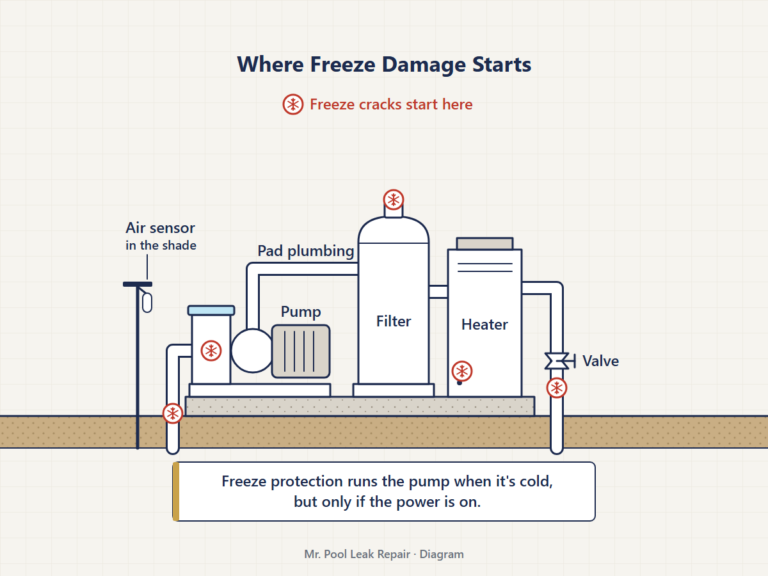
Walk the equipment pad first, where a leaking union or weeping filter leaves wet concrete or white mineral crust. If the pad’s dry, the leak’s probably underground. Our page on a pressure line pool leak covers every spot on that side that can leak, waterfalls included.
If a section of deck has started to drop too, don’t sit on it. Water from a buried line can wash soil out from under the slab, as our page on an underground pool pipe break explains.
What the 3-Year Pipe Warranty Covers
Once we’ve found the leak, most pipe repairs take one to two days. Every section of underground pipe we repair carries our 3-year pipe warranty, whether it’s a skimmer, return, main drain, or water feature line. If we resealed a skimmer throat or return fitting on the same visit, that work falls under our 3-year seal warranty. Neither covers weather or fire damage, equipment leaks from pumps, filters, and valves, or work another company does later. If you sell the house, the warranty goes to the buyer for whatever’s left of the 3 years, as long as we get written notice within 30 days of closing.
What to Do Before You Call
First, find out whether the pool’s losing more than the weather takes. That’s what the 24-Hour Tape Test is for. Shut the autofill off, mark the water level on a strip of tape at the water line, and leave it a full 24 hours without adding any water. A summer pool can lose about a quarter inch a day to evaporation, and if yours dropped further, you likely have a leak. If you’ve got time, run it a second day with the pump off. More loss with the pump running points toward the pressure side, and more with it off, especially with air in the basket, points toward suction.
Leave the pressure testing and digging to someone with the equipment. A plug can blow out of a pressurized line, and digging without knowing where the break is usually just gets you a hole in the yard.
It’s time to bring us in when the tape test shows more than evaporation, the pump keeps losing prime after you’ve checked the lid, deck along the plumbing is sinking or cracking, or your water bill’s climbing while the autofill hides the loss. In Dallas, our pool leak detection in Dallas team can test every line and hand you a written report the same day. Elsewhere in DFW, dial 214-972-3330. We work out of six locations around the Metroplex.
Frequently Asked Questions
How do you fix a leaking inground pool pipe?
First you find which line is leaking and exactly where. Each line gets plugged and pressure tested on its own, and listening equipment pinpoints the break on the line that failed. Then the deck or ground is opened over that spot, the broken section is replaced with new pipe, and the line is pressure tested again before it’s backfilled.
How do you fix a pool pipe leak under concrete?
You cut the smallest opening you can, right over the break, which is why finding it first matters so much. Once the line has failed a pressure test and the leak’s been marked from the surface with listening equipment, a saw cut or core drill opens the concrete at the mark. After the pipe’s repaired and holds on a second pressure test, the hole is backfilled and the concrete is patched.
Can a swimming pool pipe be repaired without digging?
Sometimes, with an epoxy liner applied from inside the pipe. Companies that sell these systems describe drying and prepping the line, coating the inside with epoxy, letting it cure, and pressure testing afterward. Lining guidance from the sewer industry says the old pipe has to be clear of obstructions and crushed or collapsed sections for a cured-in-place liner to go in properly.
What if the broken line is the main drain?
It’s a harder repair because that pipe runs under the pool floor. You can dig up and repair the line, which is a big job, plug off the main drain and let the pool circulate through the skimmers, or run a new line around the outside of the shell. Which way to go depends on cost and how much your pool relies on that drain.
Dealing with a pool leak?
Call today to learn more about how we can help you stop your pool lines from leaking.
Mr. Pool Leak Repair serves Dallas, Plano, Frisco, McKinney, Allen, Southlake, Fort Worth, and communities throughout the DFW metroplex.