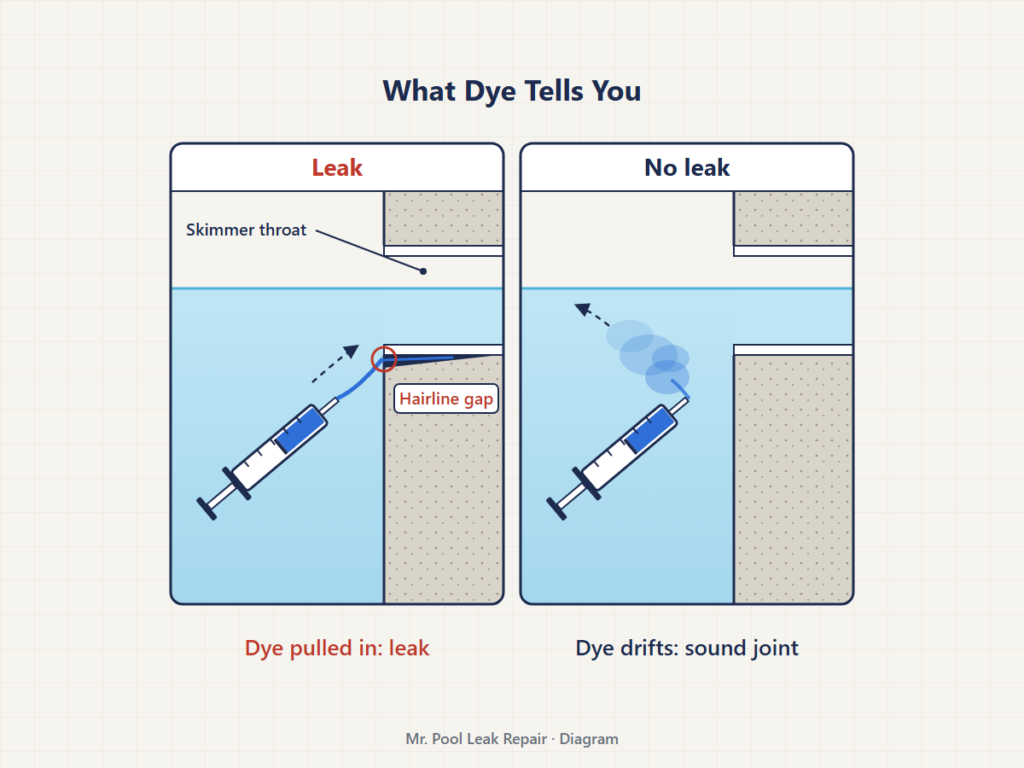
Pool dye leak detection is the part of a leak call most people picture: somebody leaning over the coping with a syringe, watching a thin thread of color next to the skimmer. In a few seconds, dye can tell you whether water is leaving through one specific fitting or crack. It can’t find a leak you haven’t narrowed down yet, or one in a pipe buried under the deck, and knowing that can save you a week of squirting dye at the wrong spot.
How Pool Dye Leak Detection Works
The dye we use is concentrated and heavier than water, so it leaves the syringe as a thin thread instead of a cloud. With the pump off and the water around the spot still, we release a small amount about a quarter inch from the fitting or crack. If water is escaping there, the thread bends toward the opening and gets drawn in, and a quick pull usually means a bigger leak. Over a sound fitting the dye hangs there and fades.
That pull is gentle, and you’ll only see it right at the opening. Even an arm moving through the water nearby can wash it out, so we’re careful with placement and we’ll dye a spot more than once before we call it a leak. Our page on pool dye testing walks through each step.
Where Dye Does Its Best Work
Dye is at its best on the seals around anything that passes through the shell, which is where most pool leaks occur. On a typical shell check we dye:
- The skimmer throat, inside and outside edges of the opening.
- Every return fitting, all the way around.
- The light niche, including the lens gasket and the conduit opening at the back, since water can run down that conduit and leave behind the wall.
- Cracks in the plaster or tile. Plenty don’t leak at all, and dye sorts the ones taking water from the ones that are just ugly.
- The main drain cover, which in a deep pool means somebody’s going to the bottom.
What Dye Can’t Find
Dye only works if you can put it close to the leak. InyoPools’ guide to dye testing a pool says the test is only effective if you already have some idea where the leak is, and it calls dye a first step before more in-depth testing.
The biggest blind spot is the plumbing. Lines run underground from the skimmers, main drain, and returns back to the equipment pad, and when one cracks, the water leaves out in the dirt. A careful dye check of every wall fitting won’t tell you a return line is broken three feet from the pool, or that a valve on the equipment pad is dripping. It also can’t tell you there’s a second leak, and older pools sometimes have two going at once.
A Week of Dye at a Coventry Manor Skimmer
From the field · Coventry Manor, Southlake
Squirting dye around the skimmer throat had turned into an evening routine for the Ashworths in Coventry Manor. They’d read that skimmers are where leaks usually start, so they kept at it for a week. Some nights they were sure the color drifted toward the opening, and other nights it sat there.
We dyed the throat, both returns, the light, and the main drain cover, and nothing pulled. We also plugged each line and pressure tested it. The skimmer line held, but the return running under the deck to the far side leaked down on the gauge. Listening equipment picked up the break a few feet out under the concrete, the only spot we had to open.
From the deck, a skimmer that’s pulled away from the shell and a break in an underground line can look almost the same. Both sit near the top of our list on older pools during a Southlake pool leak detection call.
Why We Pressure Test Every Line Too
A pool usually has 4 to 8 separate underground runs, and we test each one by itself. With the openings at the pool plugged, we bring each line up to 15–20 PSI and watch the gauge for 15 to 20 minutes. If the pipe’s intact, the needle stays where we left it. Any creep means a leak somewhere along that run, and if it drops all the way to zero, the pipe has usually come apart underground.
The gauge only tells us which line is leaking, so we put air in that line and listen along the run until we hear the break. That way the deck gets opened in one spot instead of four. We run pool pressure testing alongside the dye so we don’t end up resealing a skimmer that was never the problem.
Food Coloring vs. Leak Dye
Some DIY guides say food coloring will do, including Bob Vila’s guide to finding a pool leak, which suggests squirting a little around fittings to see if it gets pulled toward a leak. Up close in still water, it’ll work in a pinch. Test-kit dye is concentrated and, as the InyoPools guide puts it, designed to stay together in the water. Food coloring isn’t, so it spreads fast and you get one short look before it fades.
For a quick look at one spot you already suspect, food coloring is fine. On the small, slow leaks we run into most, it clouds up before you can tell which way it’s heading. If you’re checking more than a couple of spots, get a leak dye kit with a syringe.
What Happens If a Dye Test Fails
If the dye got pulled in, the test did its job: you’ve found a leak at that spot. Leaks at skimmer throats, return fittings, light conduits, and small cracks can often be sealed the same day without draining. Seal work on throats, return fittings, and light niches carries our 3-year seal warranty.
If nothing pulled anywhere and the pool’s still losing water, either there’s a spot nobody’s dyed yet or, more likely, the leak is in the underground plumbing, and that’s a job for the pressure test.
How Much It Costs to Check for a Pool Leak
Fixr’s swimming pool leak cost guide puts professional leak detection at $100 to $500 and a pressure test of the lines at $200 to $500, and notes that pipes buried in the ground can cost more to find.
Our detection price depends on the pool’s size and how much plumbing there is to test, and you’ll know it before we start. You get a same-day written diagnostic report and repair estimate, and our repairs average about $2,500.
What to Try Before You Call
Hold off on buying dye until the 24-Hour Tape Test shows a leak. With the autofill turned off, run a piece of tape along the tile at the water line and draw your mark on it. Don’t top the pool off for 24 hours, then check the mark. A summer pool can give up about a quarter inch a day to evaporation, and a drop beyond that likely means a leak.
If you’ve got a suspect spot, like a crack you can see or a gap at the skimmer throat, go ahead and try dye there. Don’t make a week of it, though. If a few careful tries don’t pull anything in, the leak’s probably somewhere dye can’t reach, and that’s the time to call. Call too if the spot is the main drain or the light niche (it’s wired, so leave it to us).
If you’re in Colleyville, where many pools have been through 20 or 30 Texas summers, start with our page on pool leak detection in Colleyville. If you’re somewhere else in DFW, 214-972-3330 will get you on the schedule, or you can look up your symptoms in our Pool Leak Knowledge Hub.
Frequently Asked Questions
Is pool leak dye safe for my pool?
Professional leak dye is non-toxic and non-staining, and the small amount we use disperses within minutes. It won’t change your water chemistry or mark plaster, pebble, fiberglass, or vinyl. If you’re testing on your own, use dye sold for leak testing and release a little at a time.
Does the pool have to be drained for a dye test?
Dye testing is done with the pool full, because you’re watching water carry the dye into a leak. The pump goes off so the water around each spot is still. Many of the leaks we find this way can be sealed with the water in too, so a dye test doesn’t usually lead to an empty pool.
Can dye find a leak in the main drain?
It can, as long as somebody gets down there. Testing the cover means diving to the bottom of the deep end, so it gets skipped on a lot of homemade dye tests. If the cover checks out, the drain line under the floor still needs a pressure test, because dye at the cover won’t show a crack farther down the pipe.
Dealing with a pool leak?
Call today to learn more about how we can help keep your pool from losing water.
Mr. Pool Leak Repair serves Dallas, Plano, Frisco, McKinney, Allen, Southlake, Fort Worth, and communities throughout the DFW metroplex.