A pool autofill running constantly means water is leaving somewhere, even if the water line hasn’t moved in months. The autofill puts back whatever the pool loses, and it can’t tell evaporation from a cracked return line, so it covers for both. Most people find out from the water bill. In December the sun isn’t taking much, so if the autofill’s still filling every day, it’s worth finding out why.
How a Pool Autofill Valve Works
On most pools we see, the autofill sits in the deck under a round plastic lid. Pentair’s installation manual for its automatic pool filler shows how the common in-deck type goes together. A leveler bucket is set in the deck with its top even with the pool’s bond beam, and a straight equalizer pipe connects its bottom to the pool, so the water in the bucket sits at the same height as the pool. A fresh water line feeds a brass valve on a float arm, and an overflow pipe leaves the bucket near the top.
When the pool drops, the float sinks and opens the valve, then rises and shuts it once the water’s back. The height is set with a wing screw on the float arm, and the manual’s drawing puts the water at about the middle of the tile.
What Keeps a Pool Autofill Running Constantly
It usually comes down to one of three things, and only one of them is a leak.
The Fill Valve Is Stuck Open
The bucket sits at deck level, so leaves, sand, and hard-water scale can build up in it and keep the float from rising or the valve from seating. Irvine Ranch Water District’s pool tips say that if your pool fill is running longer than usual, the float may be stuck or need adjusting.
Pop the lid and lift the float arm by hand. If the water stops, the valve works and the float was hung up or set too high. When water keeps coming even with the float all the way up, the valve’s worn or has grit in the seat.
The Water Level Is Set Above the Overflow
If the float arm gets set higher than the overflow (or bumped while somebody cleaned the bucket), the valve never sees the water it’s waiting for. It keeps filling, and the extra runs back out the overflow. Find where the overflow pipe comes out in your yard and check it on a dry day. If it’s running when it hasn’t rained, lower the float arm.
A Leak the Autofill Is Covering For
If the valve shuts off when you lift the float and the overflow’s dry, the pool really is losing water. The Arizona Municipal Water Users Association warns that an autofill can hide a leak by adding water automatically, so you may never notice the level dropping. That’s how a cracked return line or failed light niche seal can run for months.
How to Stop the Autofill and Find Out Which Problem You Have
To stop a pool autofill, close the valve on its water supply. Arizona’s Water Use It Wisely conservation campaign says the pool’s supply line is usually the first line off the backflow device at the back or side of the house.
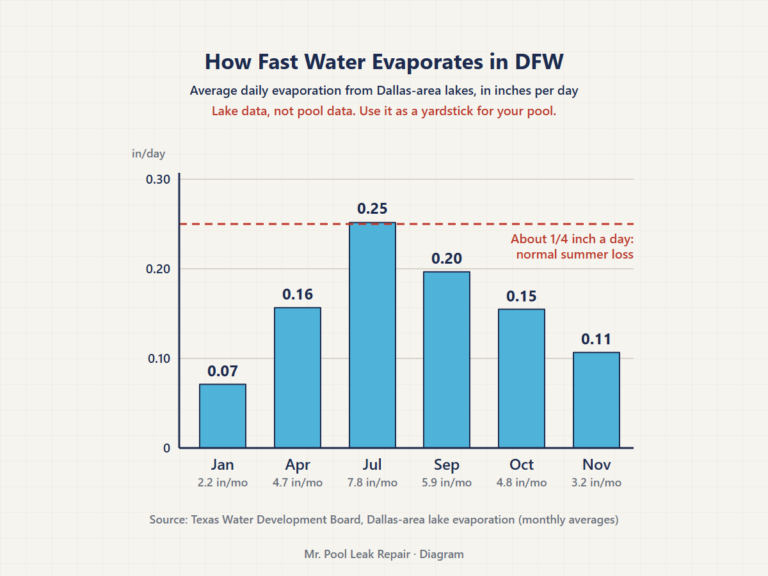
Then run the 24-Hour Tape Test. Stick tape on the tile at the water line, mark the level, and check it again 24 hours later without adding a drop in between. Summer evaporation can account for about a quarter inch a day, so if it dropped more than that, you likely have a leak. In December it ought to lose less.
- It dropped more than a quarter inch. The autofill was likely covering a leak. Leave it off until the leak’s found, but if the water gets near the bottom of the skimmer opening, turn it back on so the pump doesn’t pull air.
- Barely any drop, even though the autofill ran nonstop before. The trouble’s in the leveler, either the valve or the float setting.
- The pool held, the valve shuts off, and the overflow’s dry, but the bill’s still high. Water may be leaking out of the fill line before it reaches the pool.
When the Leveler Itself Is Leaking
An autofill is plumbing too. The bucket and equalizer pipe hold pool water below the water line, so a crack in either one drains the pool like a cracked skimmer would, and the tape test catches it.
A leak on the supply side is sneakier. That’s city water escaping between the house and the bucket, so the pool holds fine while your meter keeps turning. The Pentair manual tells installers they can pressure test the fill line with a plug where the valve goes, and we run the same check on leak calls: plug and pressurize the line, then see if the gauge holds.
A Craig Ranch Pool That Hid a Return Line Leak
From the field · Craig Ranch, McKinney
Nothing looked wrong with the Dunleavys’ pool in Craig Ranch. The water sat at the middle of the tile, where it had been all year. What bothered them was a water bill that had been creeping up since spring. They’d blamed the heat and the sprinklers until they shut the autofill off for a day and the pool dropped well past a quarter inch.
We pressure tested each line from the equipment pad, and the needle crept down on one return line. Through the headphones, that leak was loudest under the deck. We saw-cut the concrete there to replace the cracked section and retested before patching. Their old bills showed it had been leaking for most of a year.
Return lines lose the most water while the pump’s pushing it, which an autofill can easily hide. Our page on a return line leak covers the other signs.
What a Hidden Leak Does to a McKinney Water Bill
McKinney buys its water from the North Texas Municipal Water District, and residential rates are set up so each gallon costs more the more you use. Water an autofill adds for a leak lands on top of a summer of sprinklers, where the price is already highest. If the bill is what tipped you off, our page on a high water bill with no visible pool leak has a few more checks, including the water meter.
When It’s More Than the Valve
Get the lines tested if the tape test drops more than a quarter inch, if the pool holds but the bill won’t come down, or if you’ve fixed the float and the autofill’s still running. A valve that’s simply stuck is a parts job your pool service can usually handle.
On a pool leak detection visit, we pressure test the plumbing lines one at a time and put listening equipment on any line that won’t hold. We also check the shell, fittings, and equipment pad. The written diagnostic report and repair estimate are yours the same day, and our repairs average about $2,500. In McKinney, call our pool leak detection team in McKinney. Our main line, 214-972-3330, covers the rest of DFW.
Frequently Asked Questions
Why is my pool constantly filling up with water?
Your autofill is either replacing water as fast as the pool loses it, or it’s stuck open and feeding the overflow. Lift the float by hand first. If the water stops and the overflow’s dry, shut the autofill off and run the 24-Hour Tape Test. A drop of more than about a quarter inch a day in summer points to a leak the autofill has been covering.
How do I stop my pool autofill?
Close the shut-off valve on the autofill’s water supply. On many houses that line comes off the backflow device at the back or side of the house. Lifting the float arm stops the flow for a moment, but closing the supply is the sure way to keep water out during a leak test. Turn it back on once the test is done.
Can a pool autofill raise my water bill?
An autofill that’s working right only puts back what evaporation and splash-out take, so it shouldn’t move your bill much. When it’s covering a leak or running out the overflow, it can fill every day for months, and that water gets billed like any other. A bill that keeps climbing while the pool always looks full is usually what gets people to call us.
Dealing with a pool leak?
Call us today to learn more about how we can help you stop that leak.
Mr. Pool Leak Repair serves Dallas, Plano, Frisco, McKinney, Allen, Southlake, Fort Worth, and communities throughout the DFW metroplex.