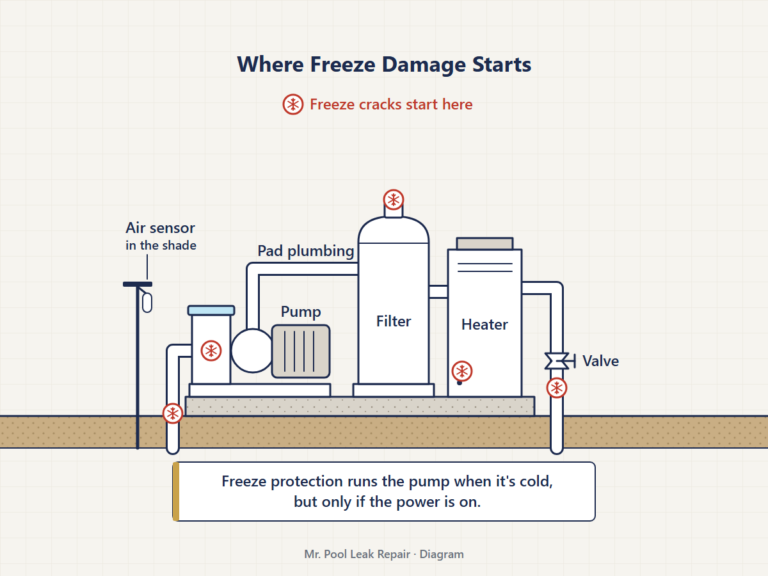
What happens if you don’t fix a pool leak tends to sneak up on you. For the first few weeks not much seems to change, because the autofill keeps the pool topped off and the bill only creeps up a little. But the water that’s leaving has to go somewhere, and it nearly always ends up in the ground beside your shell or under your deck. I’ve been on plenty of calls where fixing the leak turned out to be the easy part, and the bigger job was repairing what the water had done in the meantime.
What Happens If You Don’t Fix a Pool Leak
You pay for the water first, along with the chemicals that go out with it. After a while the leaked water starts working on the soil around the pool, and that’s when a small repair grows into a pipe or structural repair. If the level drops far enough, the pump can get hurt too. And if you sell the house with the leak still running, a buyer’s going to want money off for it.
Most of the leaks we find early are seal jobs at a fitting or a skimmer throat, usually done in a single visit with no digging.
How Much Water a Small Leak Wastes
In a Texas summer a pool can lose about a quarter inch a day to evaporation, so that much is normal, and the leak is whatever goes on top of it. Say your pool is about 15 by 30 feet and it’s losing another quarter inch a day. That’s 450 square feet of water surface, and one inch across it comes to about 280 gallons (450 square feet times a twelfth of a foot, times about 7.48 gallons per cubic foot). So a quarter inch is about 70 gallons a day. Over a 30-day month that’s roughly 2,100 gallons, and over a four-month summer it’s around 8,400.
If your pool’s a different size or shape, our pool leak calculator will give you a rough daily figure to compare against.
With an autofill, you won’t see any of that at the waterline, because the valve keeps replacing what leaks out. What you’ll notice is the bill, higher than last summer’s for no reason you can name. Our page on a high water bill with no visible pool leak covers how to rule the pool in or out.
In Allen, that water also gets pricier the more of it you use. The city buys its water from the North Texas Municipal Water District, and Allen’s water and waste rate page shows the residential price stepping up as a household’s use goes up. In summer you’re already watering the yard hard, so the leak lands on top of that and gets billed at the higher steps.
Every gallon that leaks out also takes chlorine and stabilizer with it, and the autofill replaces it with plain tap water. A leaking pool often won’t hold its chemistry, and algae can keep coming back when you’re doing everything right.
What Leaking Water Does to the Soil Around Your Pool
The bigger cost is underground, where water leaving through a skimmer throat, a light niche, or a cracked return line soaks the same patch of ground beside the shell or under the deck day after day.
Around Allen and most of Collin County, that ground is expansive clay, the black clay that swells when it’s wet and shrinks when it dries. A homeowner guide to shrink-swell soils from the American Society of Civil Engineers’ Geo-Institute says uneven changes in soil moisture do more damage than uniform ones, and it lists leaking water lines as a localized source of water that can lead to localized foundation movement. A pool leak is about as uneven as moisture gets, since every drop of it goes into the same spot.
Water that keeps moving through the ground also carries soil with it, especially the looser backfill around buried pipe. Fixr’s pool leak cost guide says soil erosion and muddy lawns are very common with ongoing leaks, and that a leak left long enough to erode the soil can cause a sinkhole.
On jobs where a leak has been running a while, the signs are pretty consistent:
- A section of deck has dropped along the line where a pipe runs underneath.
- A hollow sound when I tap the slab with a hammer, where the soil under it has washed out.
- An open mastic joint between the deck and the coping.
- On a suction-side break, sand or dirt in the pump basket that got pulled in through the crack.
How a Seal Job Turns Into a Pipe or Structural Job
Most leaks start small, with a worn seal at a return fitting or a skimmer throat letting water get behind the shell. If that’s fixed early, it’s a seal repair covered by our 3-year seal warranty. Left alone, the clay behind the wall stays wet and swells, and the deck above it starts to move. That movement strains the plumbing underneath, so a fitting or an elbow that was sound can crack under it, leaving you with a second leak under the concrete.
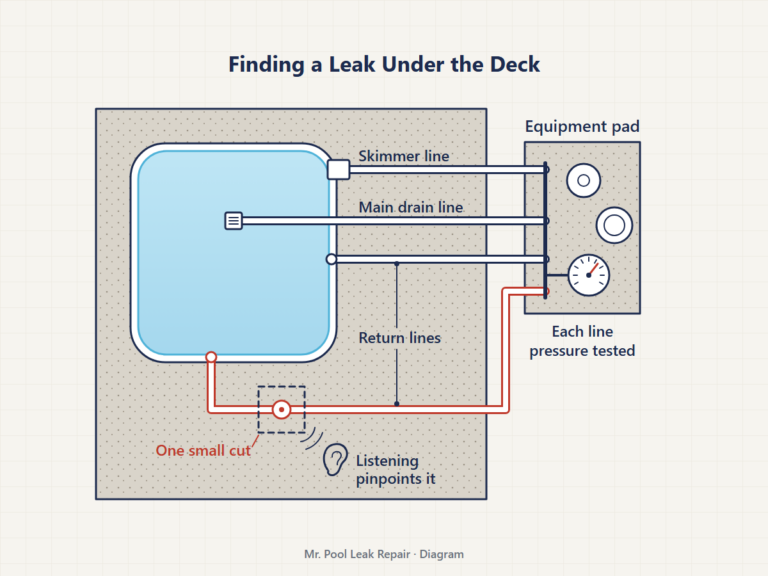
On our own jobs, a seal leak left for about a year can turn into a pipe repair, and a pipe leak left two or three years can turn into foundation work. For a pipe repair, we plug each line and pressure test it to find the one where the gauge won’t hold, then use listening equipment to pinpoint the break so the deck gets cut in one spot. Repaired sections carry our 3-year pipe warranty.
Once the shell itself is moving, the fix becomes structural: staples and plaster patch on the cracks, and sometimes steel piers set with licensed Texas Professional Engineers. Pier work comes with our lifetime structural pier warranty.
A Summer-Long Drip in Twin Creeks
From the field · Twin Creeks, Allen
It was September when the Lindqvists in Twin Creeks had us out, and their pool had been dripping since around Memorial Day. The autofill kept the pool full, so the only clues were a higher water bill and a damp strip of ground behind the pool wall that never dried out. By late summer, a section of deck near one of the returns had settled and the joint at the coping had opened. Dye at the return fitting disappeared into a gap around its edge. That return line also failed its pressure test, and the listening equipment led us back to the sunken slab, with the break underneath it. By then the job had grown to a resealed fitting, a pipe repair under that slab, and a new section of deck.
Don’t count on homeowners insurance to pick up the difference. The Texas Department of Insurance says most policies cover sudden and accidental water damage, like a burst pipe, but usually won’t cover damage from gradual leaks or seepage. A drip that’s run all summer sounds a lot more like the second kind. Policies differ, so read yours and ask your agent.
When the Water Gets Low Enough to Hurt the Pump
If you don’t have an autofill, or you’re gone for a week in July, a leak can pull the level below the skimmer opening. You’ll usually hear it first, a slurping at the skimmer, and then you’ll see bubbles coming out of the returns and a pump basket that’s half full of air.
HomeAdvisor’s pool repair cost guide warns that if the waterline drops too low, the pump can suck in air and burn out. Even short of that, running low on water wears out a pump’s seal and impeller faster.
Selling a House With a Pool Leak
Buyers’ agents know to ask about the pool, and many buyers order a pool inspection during the option period. We do those inspections, and when a leak turns up at that stage, the buyer is pricing a job nobody’s scoped yet, so they tend to assume the worst. Our page on whether a pool leak affects home value compares repairing before you list with selling the house as-is.
A repaired pool is an easier conversation, because you’ve got the written report and a written warranty to hand over. Our warranties can go to the buyer with written notice within 30 days of closing. The pier warranty then runs 5 years from closing, and the 3-year pipe and seal warranties run out whatever’s left of their term.
Is It Expensive to Fix a Pool Leak?
Caught early, most leaks aren’t. Fixr’s pool leak cost guide puts pool leak repair at $500 to $1,500 nationally, with an average of $1,000, and lists underground pool pipe repair in that same $500 to $1,500 range. HomeAdvisor’s pool repair cost guide says to expect $350 to $2,700 to repair an in-ground pool leak, with draining, refilling, and treating the water on top of that.
Our repairs average about $2,500. That’s above Fixr’s national average because it blends quick seal jobs with pipe breaks under concrete and structural work, and the bigger jobs are mostly the ones that waited. Our page on pool leak repair cost explains what moves the price. You’ll get a same-day written diagnostic report and repair estimate, so the price is on paper before we pick up a tool.
How to Check Your Pool Before You Decide to Wait
You can measure it yourself with the 24-Hour Tape Test. Turn the autofill off first, then put a strip of tape at the water line and mark where the water sits. Add nothing for 24 hours, and check the mark. Summer evaporation takes about a quarter inch a day, so if the mark shows more than that, you likely have a leak.
If it did drop, I’d book leak detection now instead of waiting. DFW pools keep running through the winter, so the leak keeps going after swim season ends. I’d also skip the leak sealer from the pool store, since it can slow a leak enough to hide it without fixing whatever failed.
Pick up the phone if you’re seeing any of these:
- The tape test shows more loss than evaporation would explain.
- Your autofill runs every day, or the water bill jumped and nothing else changed.
- A section of deck has dropped, the coping joint has opened, or there’s a soggy spot in the yard that never dries.
- The skimmer’s sucking air or the pump keeps losing prime.
On a pool leak detection visit we pressure test each line, put dye at the fittings and cracks, and use listening equipment on anything underground, and you get the written report the same day. If you’re in Allen, our Allen pool leak detection crew works in Twin Creeks and all over town. If you’re not in Allen, 214-972-3330 gets you any of our six locations.
Frequently Asked Questions
Where is the most common place for a pool leak to occur?
Most of the leaks we find are at the seals around skimmer throats, return fittings, and light niches. Heat and chlorine wear them out, and soil movement pulls them apart. Underground plumbing lines, cracks in the shell, and the equipment pad are the other usual spots. We test every line, fitting, and crack on a job, because what looks like one leak sometimes turns out to be two or three.
How much does a pool leak add to the water bill?
That depends on the size of the pool, how fast it’s leaking, and what your city charges. On a 15 by 30 foot pool, a leak of a quarter inch a day beyond evaporation is about 70 gallons a day, or roughly 2,100 gallons a month. In cities where the price goes up as use goes up, those gallons cost the most in summer, when you’re already watering the yard.
Can a pool leak damage the deck?
Leaked water soaks the clay beside the shell and under the deck, and over time it carries loose soil away from around buried pipe. That leaves gaps under the slab, so the deck drops or cracks, often along the line of the pipe. When a section’s already dropped, we fix the leak first and then the concrete.
Is it OK to wait until the end of summer to fix a pool leak?
Summer’s the most expensive time to let a leak run. You’re refilling every day on top of the yard watering, when water costs the most, and the same patch of clay never gets a chance to dry out. We’ve seen seal leaks that would’ve been a one-visit fix in June turn into pipe and deck work by September. Run the 24-Hour Tape Test now so you’re deciding with a real number.
Dealing with a pool leak?
Call today to learn more about how we can help you stop your pool from leaking before it costs you more.
Mr. Pool Leak Repair serves Dallas, Plano, Frisco, McKinney, Allen, Southlake, Fort Worth, and communities throughout the DFW metroplex.